
What Are More Classroom Station Ideas for Middle School Science?
Are you ready for more classroom station ideas? Using science stations in the classroom is a great way to have students practice what you’ve taught them. Let’s talk about more classroom station ideas for our middle school science classrooms!
In this Post
We’ll do a quick recap the what and why about stations. Then I’ll give you some classroom station ideas you can add to your science units. I’ll also give some preparation tips and grading ideas.
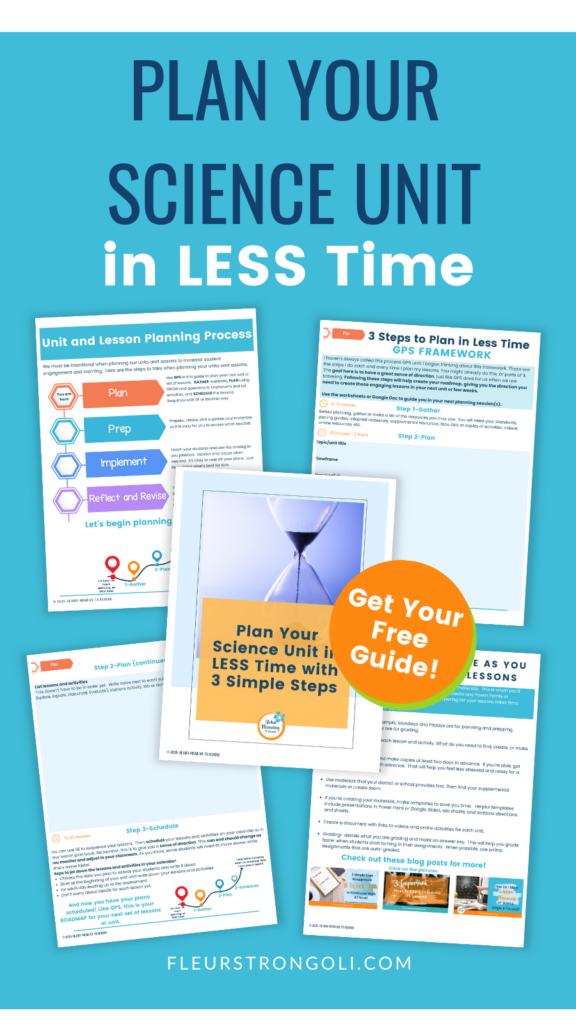
Before you start planning, be sure to grab your free guide! Plan Your Science Unit in LESS Time with 3 Simple Steps!
The What and Why of Science Stations
Science stations during 5E Elaborate are a variety of activities that students complete. Normally during independent or group work time, we give students assignments like worksheets, labs, or projects.
Science stations allow for a variety of activities that takes about 2-3 class periods to complete. This gives students different ways to work with and practice the material that they have learned. They are able to work alone or with a small group, leading to conversations about the concepts. We give them deliberate, repeated practice so they can work with the material to move it into long term memory.
What are Classroom Station Ideas?
We can use a lot of different stations in our classrooms. It’s important to choose the types of activities you think are the most beneficial for your students. I will give you a list of classroom station ideas along with preparation tips and grading ideas.
Yes, preparing for stations takes some time. It is totally worth it. Once you have everything made, you don’t have to do it again…unless you want to make changes!
In this blog post, What Are Science Stations in the Classroom, I went over four of my main stations I use in my classroom. They are the vocabulary station, make a model station, sorting station, and computer station. Be sure to read this for more detailed information.
Today we will go over some additional classroom station ideas including a reading station, writing station, task cards station, math in science station, research station, and experiment station.
Reading Station
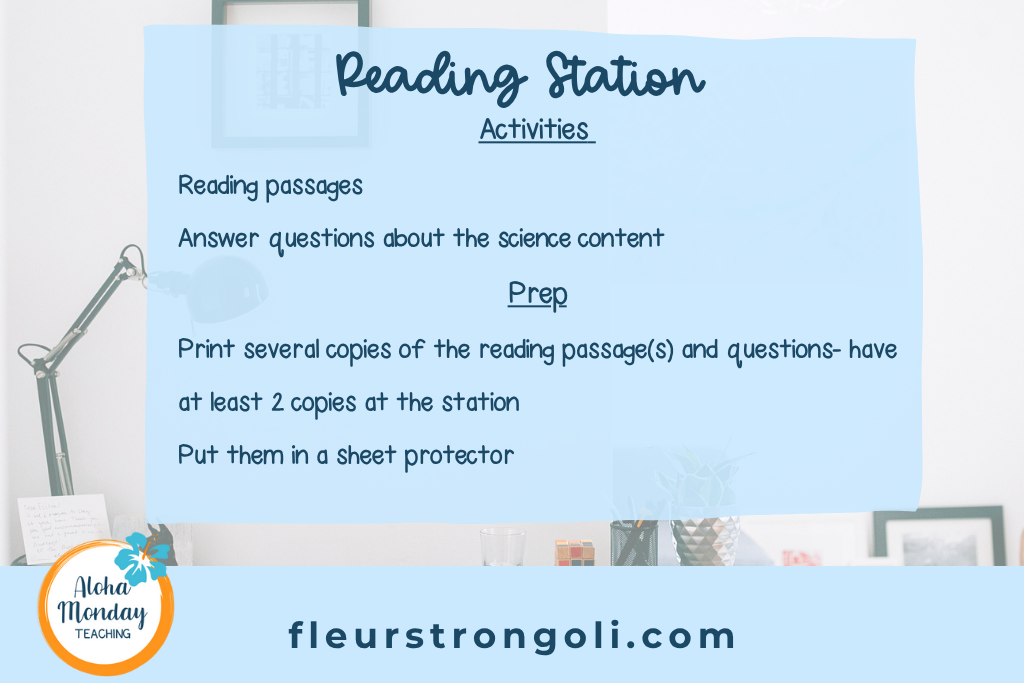
I like to have a reading station when there is more time and I have reading passages. You can use your textbook, your supplemental resources you likely have, websites like Readworks or Science Kids Magazine for reading passages and articles. You can also type your own.
In this station, students read an article and answer comprehension questions about it. I like to focus on the science concepts when I ask questions rather than just reading comprehension questions. I want them to read and pull information from the text to answer questions or explain a response. For example, instead of asking “What is the main idea” about a passage about Albert Enstein, I might ask, “What were 2-3 of Einstein’s contributions to science?”
To prepare for this station, find reading passages. Make copies if needed and put them into sheet protectors. You’ll need at least two copies for each station. That way you can reuse them over and over again. Prepare questions that students can answer in their notebooks, on a separate sheet of paper, or on a recording sheet.
Writing Station
You can include a writing station that goes along with the reading station or is separate. I like to have students write a CER (claim, evidence, reasoning) paragraph in a writing station. I write a question based on what they have learned and what I want them to review. They use their resources and notes as evidence when writing their CER.
Task Cards Station
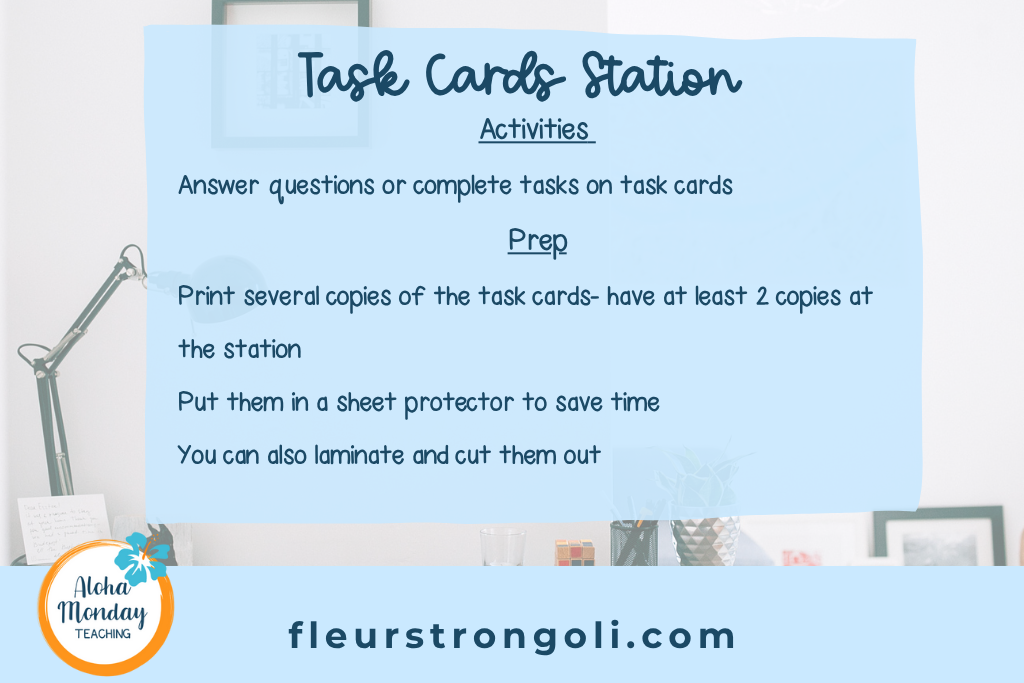
If you like to use task cards and have some handy, this is a great station to add. It is like practicing with a worksheet but in a different format.
To prepare this station, I print out the task cards and a recording sheet. To save time, I just put the task card sheets in a sheet protector rather than cutting them all out. I grade for accuracy.
Math in Science Station
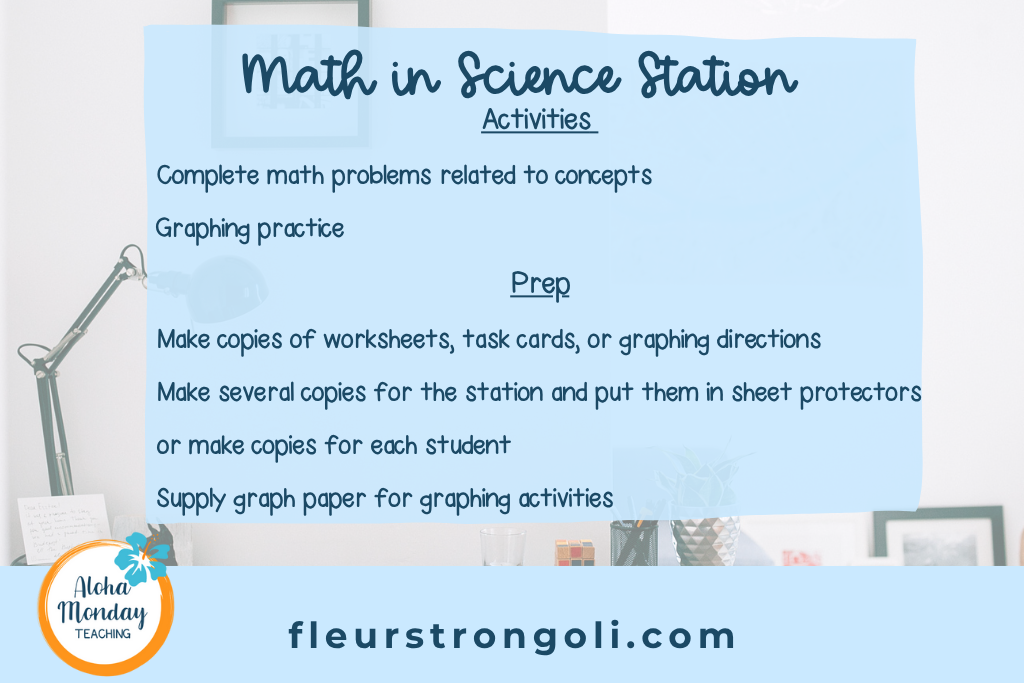
Some science units work great with math. I like to put a worksheet or task cards in a math in science station to give kids practice. I use this mostly with physics or chemistry, but you can have this station in any area of science. You can also put a graphing assignment in the math in science station if there are no formulas to practice in your science unit. They always need graphing practice!
To prepare this station, decide on what math you want students to practice- calculating or graphing. Then make copies and put them in sheet protectors. Provide students with a recording sheet and a calculator if needed.
Research Station
You might want students to research a topic to go more in depth. If so, provide a question or a list of people or topics to research. Keep this short so they can complete it in a few class periods. If you come up with ideas for this station, you might want to change it into a project that the whole class does. Just a thought.
Experiment Station
If you’re not doing many labs in a science unit, or you want to give kids more hands-on practice, this station is a great one to add. Because students will be doing this independently, you’ll want to keep it simple and make sure the directions are clear.
To prepare this station, gather your materials and type of clear directions. Remind students of lab safety too.
Wrap Up
We reviewed the what and why of science stations in the classroom. I also gave you more classroom station ideas with some tips on preparing and grading.
Your Turn
What are some science stations you use? What will you add to your next science unit?
Read More
What Are Science Stations in the Classroom?
How Do You Manage and Use Science Stations in the Classroom Effectively?
5 Engaging and Simple Ways to Practice Vocabulary About Science
5 Independent Work Ideas and the Routines Students Need to Know
The Science Teacher List of Free Resources for Teachers
Links
Plan Your Science Unit in LESS Time with 3 Simple Steps!
Cells Activities Stations Bundle
Rocks and Minerals Stations Bundle
Editable Stations Signs (to post directions at each station)
Acrylic sign holders (this is what I use to hold my station directions)
Scotch Laminator and Laminating Pouches (this is what I use in my classroom)
Sheet Protectors (I use these for task cards and reading passages)